Commercial Light Display Installation: Best Practices for Event Professionals
The most beautiful light display in the world is worthless if it is not standing, powered and safe by opening night. Installation is where commercial light display projects succeed or fail, and it is almost always a schedule problem: the venue is booked, the marketing is printed, and the crew has one window to deliver. Professional installation is not brute force — it is a repeatable engineering process. This guide distills the best practices that experienced event professionals and manufacturers use to install large holiday lights display and festival installations on time, safely and without surprises.
Phase Zero: The Site Survey That Saves Everything
Installation success is decided before the first truck arrives. A professional site survey captures five things: ground conditions (soil type for anchoring, paving for ballast, slopes and drainage), overhead clearances (trees, power lines, canopies), access routes (can a 12-meter truck reach the installation point? Can a crane?), existing services (buried cables, irrigation, lighting circuits), and permit requirements (municipal approval for structures, electrical permits, noise constraints). The survey output is a marked-up site plan that the entire project — design, shipping, rigging and installation — keys off. Buyers should always insist that the manufacturer or installer performs a physical survey; a survey done from a map is how displays end up centered on a buried water main.
Foundations and Anchoring: The Invisible 40%
Large lanterns are sail-like structures, and their stability comes from work the audience never sees. Depending on the surface, the professional toolkit includes concrete pad foundations with embedded anchor bolts, surface-mounted ballast weights calculated from the overturning moment, and ground screws or stakes for lighter pieces. The rule is that anchoring is engineered, never improvised. For a 15-meter light archway or tunnel, the anchor plan should arrive as a calculation, not an on-site guess, and it should be matched to the venue's local wind and snow design values. In our project files, the single most common installation failure across the industry is inadequate anchoring on paved plaza surfaces — the solution is modular ballast blocks or a concrete footing plan agreed at the survey stage.
Assembly: Pre-Built Sections and the Right Crew
Modern festival lanterns ship as numbered, pre-assembled sections precisely so installation can be fast. A 20-meter dragon lantern, for example, typically arrives in six to ten sections that bolt together with color-coded hardware. The assembly sequence matters: structure before skin, skin before lighting, lighting before control wiring. A competent crew of four to six installers plus a rigger can erect a mid-size festival display in three to five days; a full park installation runs two to four weeks depending on scale.
Who should install? Three options exist, and each has its place. Manufacturer-supervised installation (your crew, their engineer on site) is the best value for repeat venues. Turnkey installation by the manufacturer's crew is ideal for complex hero pieces and tight schedules. Local contractor installation works only if the contractor follows the supplier's manual and passes a pre-installation briefing — never hand a contractor a box of sections and a hope.
Electrical Distribution: The Hidden Spine
Light displays are electrical projects first. Professional installation plans the power chain end to end: venue supply points, distribution boards, sub-distribution to zones, and final connections to each fixture. Three practices separate professionals from amateurs:
- Balance the load. A display with 30,000 LED nodes draws real current, and unbalanced phases trip breakers. The installer should produce a load schedule and balance circuits across the venue's supply.
- Protect every connection. Outdoor connections use IP67-rated connectors or sealed junction boxes; indoor displays in damp spaces get the same treatment. Relying on tape and hope is how displays die in the first rain.
- Test as you go. Energize each zone when it is complete, not all at once at the end. Zone-by-zone testing finds faults while the crew is still on site, and it is the fastest way to compress the commissioning schedule.
Power distribution also shapes the guest experience. Control cabinets should be placed out of sight or camouflaged, cable runs should follow the structure rather than hang across sightlines, and all walkway-adjacent cabling must be protected against both weather and foot traffic.
Commissioning and the Opening Checklist
Commissioning is the formal handover from installation to operation, and it should be documented. The commissioning pass verifies every zone against the approved design: color accuracy, animation sequences, timing, brightness levels and emergency shutdown behavior. Two full show runs are the minimum standard — one at dusk, one in full darkness — because LED displays look completely different once ambient light drops, and fine-tuning brightness and chase speed at night is what turns "technically correct" into "magical."
Handover documentation matters as much as the show itself. The venue should receive: an as-built site plan, a zone map with power schedules, an operation manual (power-up, wind protocol, daily inspection), a spare-parts kit with the recommended spares list, and a maintenance calendar. Without this package, the venue is flying blind from night one, and every small fault becomes an emergency.
Safety: The Non-Negotiable Layer
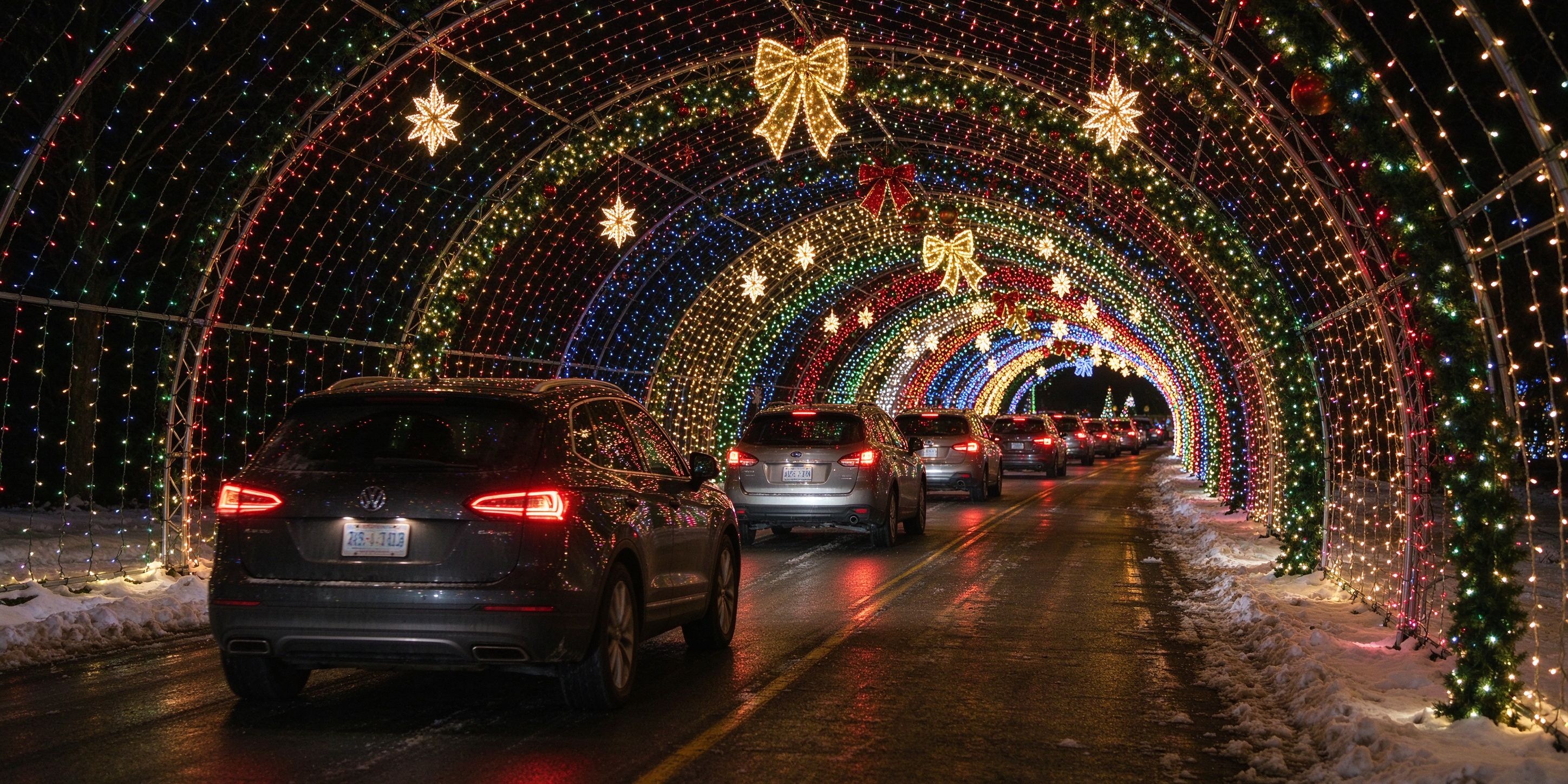
Commercial light display installation happens in public spaces, often while the venue is partially open, so safety planning is mandatory. Establish exclusion zones under lifting operations, secure all tools and hardware above head height, verify rigging with load-rated equipment, and brief the venue's security and operations teams on what is being installed and where the risks are. If the display includes interactive elements — a LED light tunnel, a light archway installation, or a rainbow arch light sculpture — the commissioning checklist must also verify touch-safe voltage, edge protection and structural integrity under crowd loads, because interactive pieces get leaned on, climbed on and pulled by children every single night.
Conclusion
Installation is where design meets reality, and reality rewards process. Conduct a physical site survey, engineer the anchoring, assemble in pre-built sections with a qualified crew, distribute power with discipline, commission at night and hand over complete documentation. Follow these best practices and the opening-night question stops being "will it be ready?" and becomes "how did it go so smoothly?" The difference is professionalism — and it is available to any event team that insists on it from the start.
Get Installation Support From the Factory
Ask about our supervised and turnkey installation services. We will review your site plan and provide a free installation plan and quotation within 48 hours.
Get a Free Quote☎ +86 13990006666 | ✉ 1712646264@qq.com